A fast-growing field called neuroaesthetics — anchored by research groups like the Johns Hopkins International Arts + Mind Lab and the NeuroArts Blueprint, a partnership with the Aspen Institute — is mapping something artists have always sensed by instinct: aesthetic experience measurably changes the brain and body, not just the mood. Susan Magsamen, the Lab's founder, points to research showing that even brief engagement with art can lower the stress hormone cortisol. The body responds to what the eye and ear take in, whether or not anyone is paying conscious attention.
Leonardo, the journal of the International Society for the Arts, Sciences and Technology, devoted its January 2026 Focus Section, "The Artful Mind," to this same territory — surveying how music reshapes neural pathways, how visual art shifts brain plasticity, and how immersive digital environments alter perception and memory. DW News covered the same shift in public understanding in a short explainer on why immersive art holds our attention so completely.
DW News — "Why our brain loves immersive art" (29 Jan 2024), featuring neuroaesthetics expert
Susan Magsamen.
Leonardo/ISAST — "Wired for Art: How NeuroArts Is Redefining Health, Healing, and Human
Connection" (Jan 2026).
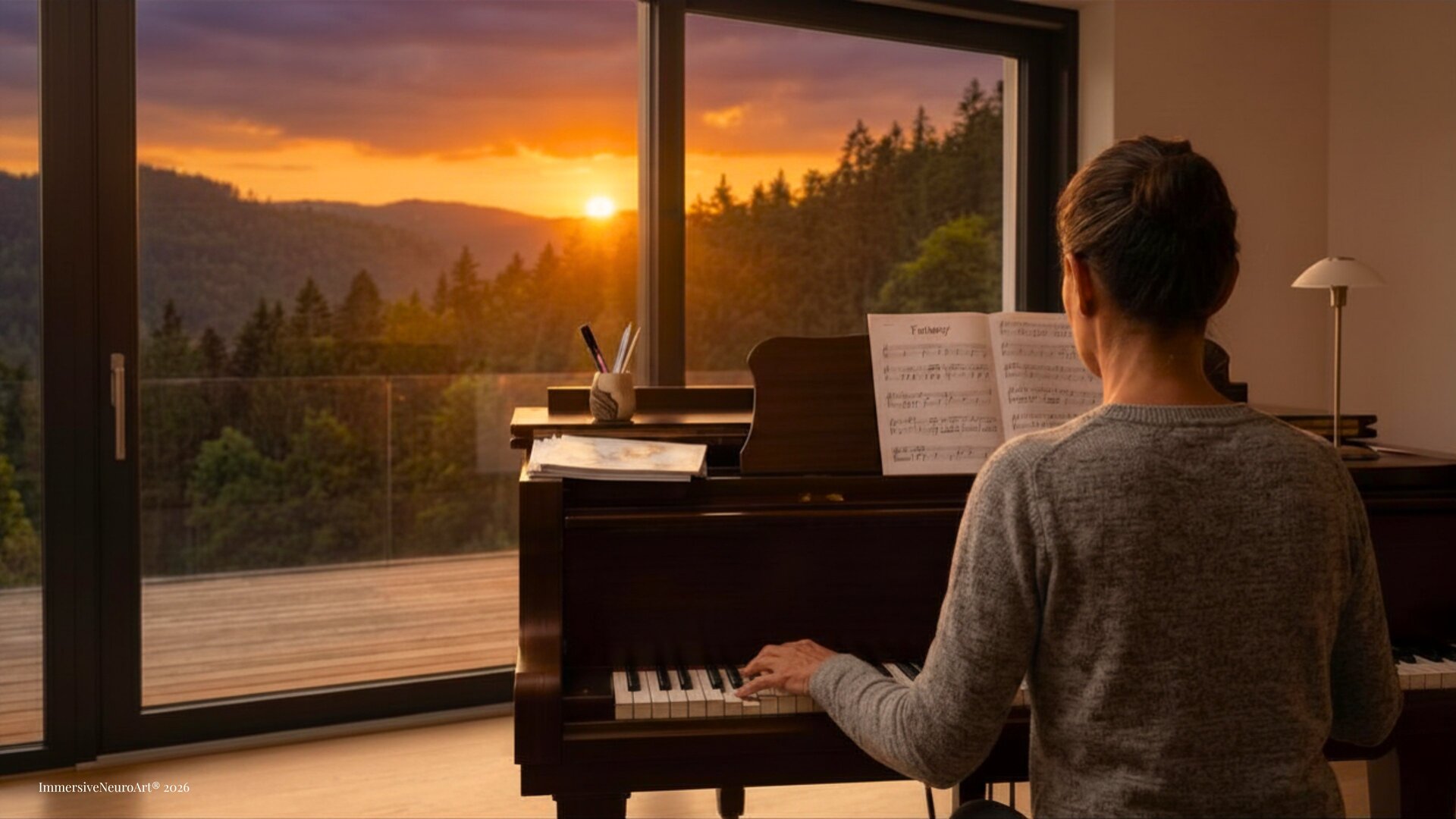
Immersive Neuro Art® takes this research as a starting point, not a finish line — translating it into a specific, repeatable practice: hand-drawn neurographic geometry, cosmic-octave tuning, and multi-sensory composition, built for three lived environments: home, practice, and hospitality.
Hand-drawn neurographic art, animated in TouchDesigner.
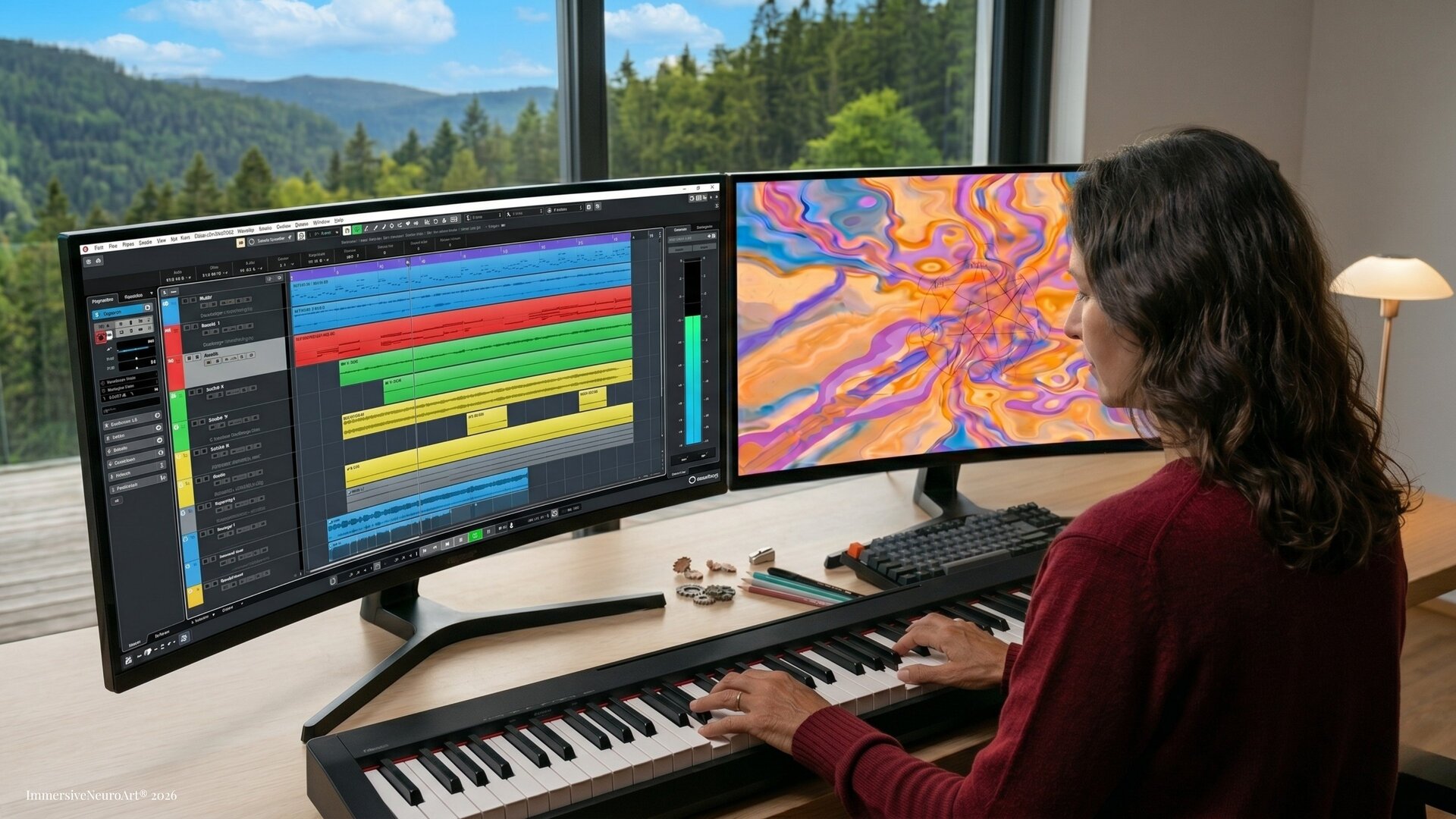
Composed in Cubase. Tuned to documented frequencies.
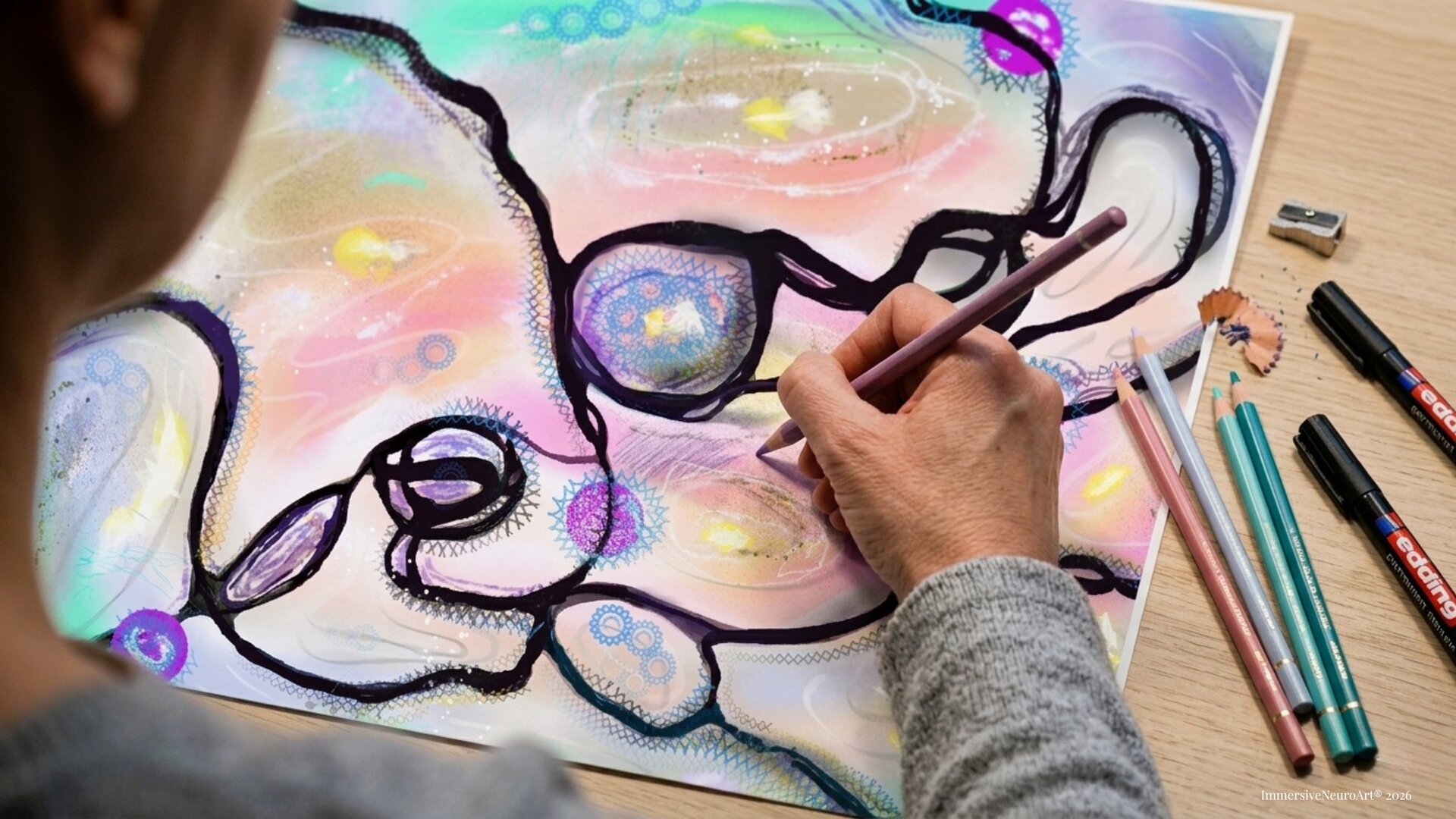
Every piece begins on paper. Pencil and pigment lines, drawn by hand in the neurographic method developed by Pavel Piskarev — flowing curves, intersections, delicate fields of color. The drawing is then scanned and brought into TouchDesigner, where it begins to breathe.
TouchDesigner is the animation tool, never the image generator. What you see is always rooted in something physical — paper that lay on this desk, ink that touched these hands. The breath patterns embedded in the animation follow heart-coherence rhythms (5+5 or 6+6 second cycles), drawn from cardiac biofeedback research.
The music is composed in Cubase. Every piece tuned to 432 Hz as base tuning — the cosmic-octave system documented by Hans Cousto (Die kosmische Oktave, 1978). Solfeggio and brainwave-entrainment frequencies can be embedded subtly into the composition, where they serve the atmosphere rather than dominate it.
None of this is mystical, though it borders on the sacred. It is mathematics, physiology, and craft — composed in service of stillness. The science doesn't make the art; the art carries the science where words couldn't reach.
I have studied with Tom Campbell, whose physicist background and binaural-beat research informed my approach to frequency-based composition.
In Joe Dispenza's workshops, my own brainwave responses were measured by EEG — showing me first-hand how kaleidoscopic visuals shift attention from analytic to absorptive states.
These experiences shaped the work — not as belief, but as foundation. What I build today combines those measurable insights with the contemplative discipline of hand-drawn neurographic art and the precision of Cubase composition.
The Aurelia — a fictional Design Hotel on Gran Canaria, built to show exactly how these visuals feel in a lobby, a spa, a lounge. The full walkthrough, room by room.
View the Aurelia Showcase